
You’ve done it. You unboxed all two dozen parts, deciphered the hieroglyphics in the instruction manual, and after a few hours, your brand-new elliptical is standing in your spare room. You’re excited to start a new routine, especially as the days get shorter here in Marysville and outdoor workouts become less appealing. You hop on for that first workout, ready to feel the burn, but instead, you feel… a wobble. Then you hear a squeak. Suddenly, your investment feels less like a high-performance machine and more like a wobbly, noisy source of frustration.
As a specialist who has spent over a decade helping people set up their equipment, I’ve seen this exact scenario play out countless times. A correctly assembled elliptical should be a silent, stable workhorse. If yours isn’t, it’s a sign that something went wrong during the build. Let's walk through the common signs of assembly issues and what might be causing them.
Common Signs and Symptoms
A new piece of fitness equipment should feel solid and reliable from day one. If you're experiencing any of the following, it’s a red flag pointing toward elliptical assembly problems.
- The Dreaded Wobble: This is the most common complaint I hear. An elliptical wobbles after assembly when it’s not structurally sound or properly balanced. You might feel a side-to-side sway as you pick up speed, making your workout feel unstable and unsafe.
- A Chorus of Clicks and Squeaks: While some minor break-in noise can occur, persistent sounds are a bad sign. An elliptical squeaking new install often points to a lack of lubrication at a key pivot point or a bolt that wasn't tightened correctly. Grinding or clicking noises are more serious and could indicate misaligned parts rubbing against each other.
- Uneven or Jerky Stride Motion: The motion of an elliptical should be fluid and seamless. If you feel a “hiccup” or a spot where the resistance suddenly changes in the middle of a rotation, it could be an issue with the flywheel, crank arms, or internal belt tension.
- Visible Gaps and Misaligned Covers: The plastic shrouds and covers are designed to fit together perfectly. If you see gaps, crooked seams, or pieces that don't look flush, it’s a strong indicator that the underlying frame wasn't bolted together squarely.
- Loose Handlebars or Pedals: This is a major safety concern. The moving handlebars or foot pedals should feel completely solid. Any play or looseness suggests the bolts securing them are either wrong, stripped, or simply not tight enough.
- Erratic Console Behavior: If your screen flickers, doesn't register your workout, or fails to control resistance, a wire may have been pinched, stretched, or improperly connected during assembly. These wires are often routed through the main mast and can be easily damaged if you're not careful.
What Causes This Problem
Understanding the root cause can help you decide whether it’s a simple fix or something that needs an expert eye. Most assembly issues boil down to a few key areas.
First, and most common, is improperly torqued hardware. Every bolt and screw has an ideal tightness. Too loose, and the machine will wobble and parts will wear out prematurely. Too tight, and you can strip the bolt, crack the plastic, or even warp the metal frame, creating stress points that lead to squeaks and failures. The instructions to “securely tighten” are vague, and it takes experience to know what that feels like.
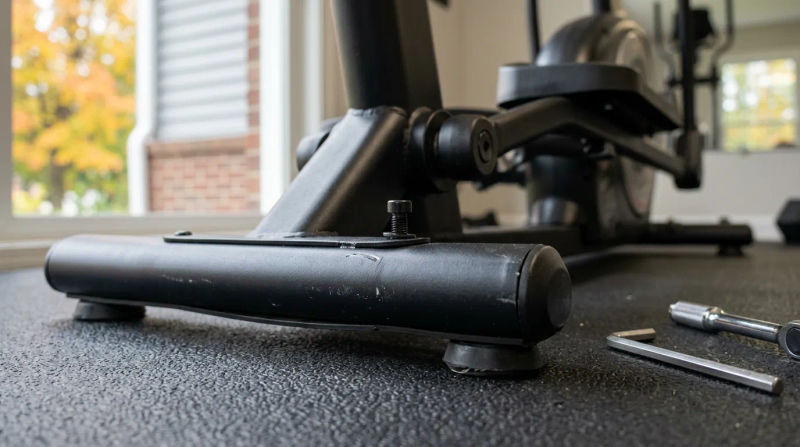
Second is an unleveled base. This is a huge issue, especially here in Marysville. Many of us set up our equipment in a spare room, basement, or a converted garage. In many of the beautiful 1960s Split-level and Ranch homes in our area, floors can settle over time and develop a slight, almost unnoticeable slope. When you place a heavy machine on an uneven surface, it’s guaranteed to rock. This is where knowing how to level an elliptical machine is critical. Most ellipticals have adjustable feet, but they must be adjusted correctly to create four solid points of contact.
Third, misaligned components are a frequent source of trouble. Elliptical manuals are complex, and it’s easy to use a bolt that’s a quarter-inch too short or to install a washer on the wrong side of a joint. These small mistakes have a domino effect, preventing other parts from lining up correctly and putting stress on pivot points, which is a primary cause of an elliptical squeaking new install.
Finally, a lack of proper lubrication during assembly is a guaranteed recipe for noise. Most ellipticals come with a small packet of grease for a reason. It’s meant to be applied to specific pivot points where metal moves against metal. Skipping this step or not applying it generously enough will result in squeaks from the very first use.
When to Call a Professional
So, your elliptical is wobbling or squeaking. Can you fix it yourself? Maybe. Here’s how I suggest my clients approach it.
First, do a simple check. Grab your manual and the tools that came with the machine. Go back through the final assembly steps and double-check that every bolt you can access is tight. Don't go overboard, but make sure nothing is loose. Next, address the leveling. Have a friend gently rock the machine while you check the feet. If one is off the ground, screw it down until it makes firm contact. Then, test the elliptical again.
If you've tightened the bolts and leveled the machine but the elliptical wobbles after assembly or the noises persist, it’s time to consider a professional. You should absolutely call for help if:
- You hear loud grinding or popping sounds, which could signal internal damage.
- You aren't comfortable partially disassembling the machine to investigate a problem.
- The issue is with the electronics, as you could cause more damage trying to fix a pinched wire.
- You’ve tried the simple fixes and the machine still feels even slightly unsafe or unstable.
An experienced professional can often diagnose and fix elliptical assembly problems in under an hour. My team and I have built these machines so many times we can often identify the problem just by the sound it’s making. We have the right tools to apply the correct torque and the experience to spot a misaligned part that a first-time builder might miss. It provides peace of mind that your investment is safe, stable, and ready for years of use.
Conclusion
Your home fitness equipment should support your health goals, not become a source of stress. A wobbly, squeaky elliptical isn't just annoying; it's often a sign of an unsafe machine that could be damaging itself with every rotation. Pay attention to the signs: wobbles, strange noises, and a jerky stride are all indicators that the initial assembly wasn't quite right. While simple fixes like leveling the feet can sometimes solve the problem, don't hesitate to get an expert opinion. Acting early will protect your investment and ensure your workouts are safe and effective as you move your fitness routine indoors this season.
If you notice any of these signs, contact a local equipment assembly professional for an inspection.